search
Loading...
Compression Springs Compression Springs

Enter your Outside Diameter and Free Length
Hint: For larger search results, enter a bigger range of Min and Max Inputs

Outside Diameter
to
Inside Diameter
to
Free Length
to
Wire Diameter
to
Total Coils
to
Rate
to
Material Type
Max. Load
to
Max. Deflection
to
Solid Height
to
*Required Field
Extension Springs Extension Springs

Enter your Outside Diameter and Length Inside Hook
Hint: For larger search results, enter a bigger range of Min and Max Inputs

Outside Diameter
to
Length Inside Hook
to
Wire Diameter
to
Max. Load
to
Max. Deflection
to
Initial Tension
to
Rate
to
Material Type
*Required Field
Torsion Springs Torsion Springs

Enter your Outside Diameter and Total Coils
Hint: For larger search results, enter a bigger range of Min and Max Inputs

Outside Diameter
to
Inside Diameter
to
Total Coils
to
Free Position
to
Wire Diameter
to
Body Length
to
Max. Torque
to
Max. Deflection
to
Rate
to
Leg Length
to
Material Type
*Required Field
Conical Springs Conical Springs

Enter you Small Outside Diameter, Large Outside Diameter and Free Length
Hint: For larger search results, enter a bigger range of Min and Max Inputs

Small Outside Diameter
to
Large Outside Diameter
to
Free Length
to
Rate
to
Total Coils
to
Solid Height
to
Wire Diameter
to
Material Type
*Required Field

How to Find Compression Springs by Size: From Micro to Heavy Duty

Compression Spring Sizes are usually the first “language” we speak when we’re trying to  replace a spring in a mechanism or spec one into a new design. In my experience, if you can describe the size (even roughly), you’re already 80% of the way to the right part.

How can I buy coil springs by size when I don’t have a part number yet?


If you’re a beginner engineer (or a student building your first mechanism), not having a part number is normal, because most designs start as a space problem , not a paperwork problem. You know the hole diameter. You know the available height. You know what you wish the spring would do. That’s plenty.

Here’s my take: don’t start by guessing the “force” and hoping the internet magically understands you. Start with the fit, then let the filters do the heavy lifting. That’s exactly why the Spring Finder exists: it’s built around searching by size ranges, not part numbers.


When you’re in browsing mode, these are the two “front doors” I recommend. One is the catalog landing area; the other is the Spring Finder when you’re ready to filter hard:

Stock Compression Spring CatalogStock Compression Spring Catalog

What compression spring sizes does The Spring Store stock?


I’ll start with the reassurance you probably came for: we have an extremely wide span of compression spring sizes, from micro coil springs to heavy-duty coil springs , so “searching by size” isn’t a dead end here.

Our ranges of compression spring sizes cover:

  • Outer Diameters from 0.036” (0.914 mm) to 9.250” (234.95 mm)
  • Free Lengths from 0.130” (3.302 mm) to 9.880” (250.952 mm)
  • Wire Diameters from 0.004” (0.102 mm) to 0.938” (23.825 mm)

On the “how much is actually in the catalog?” question: we have 31,000+ stock compression springs, with 40,000+ designs across our full catalog, including torsion, extension, and conical springs. Those counts can shift over time as inventory and listings constantly grow, adding new part numbers every few months.

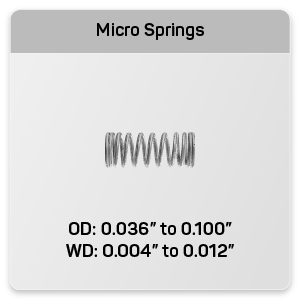
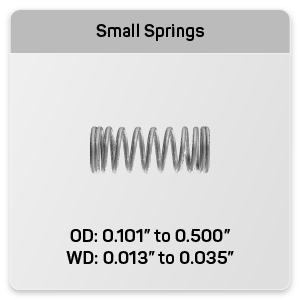
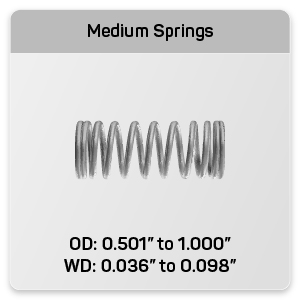
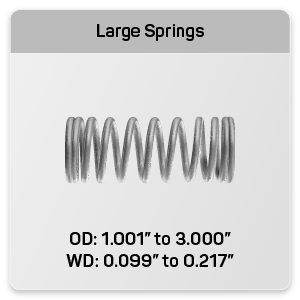
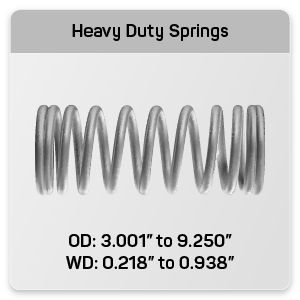
Here’s the quick-reference “by size” chart. Think of this as a practical filter-starting point (a planning tool).

Micro SpringsMicro Springs
Small SpringsSmall Springs
Medium SpringMedium Spring
Large SpringsLarge Springs
Heavy Duty SpringsHeavy Duty Springs

How do I measure coil spring size?

Let me tell you the most common failure mode I see in student projects: someone measures “about half an inch” with a ruler, orders a spring, and then wonders why it binds, rattles, or never hits the target load. Springs are forgiving… right up until they’re not. So yes, measure it. With calipers if you can.

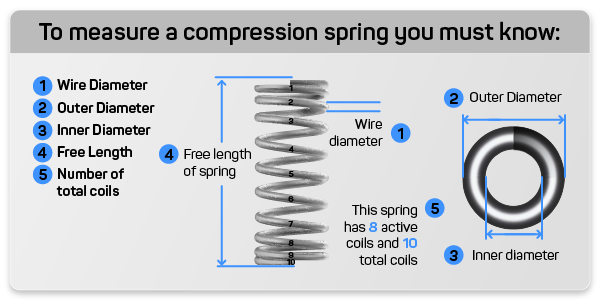
To Measure A Compression Spring Your Most KnowTo Measure A Compression Spring Your Most Know


Here’s the simplest how to measure coil spring size checklist:

  • Outer Diameter (OD) : Measure across the outside of the coil wire. This is the number that decides whether you fit in a bore/hole without scraping.
  • Wire Diameter (WD) : Measure the thickness of the wire itself. This one is a big deal because wire diameter strongly affects stiffness/force capacity, and at small sizes, tiny changes matter. One of the fractional-size pages even calls out that changing WD by 0.001" can significantly change spring strength/travel for small springs.
  • Free Length (FL) : Measure the spring’s length when it’s not loaded. This determines whether the spring physically fits the available height and how much room you have to compress.

One more note: if your spring is going inside a hole or over a shaft, don’t run your OD/ID right up against the hardware; leave clearance/tolerance (roughly 0.005"–0.025" depending on the fit).


How do I find compression springs by dimensions using Spring Finder?

This is the cleanest workflow I’ve seen for beginners who want fast progress: start wide, then narrow.  Spring Finder is split into a basic search and an advanced search, and it’s designed for dimensional ranges (min/max) so you’re not forced into a single exact number. In the basic flow, you can quickly search by outer diameter and free length, then add more fields when you need extra precision.

Spring Finder 5.0Spring Finder 5.0


I strongly recommend narrowing one dimension at a time, OD first or free length first, because you learn what your “real constraint” is while the list shrinks. Start with a broad OD/FL range, then tighten one field, then the other, until you have a manageable list you can actually evaluate and buy.

Once results are on-screen, you’re not guessing in the dark: we describe the results list as including key specifications like OD, free length, max load, max travel/deflection , and price, so you can check fit and performance before you purchase. Also, if your lab notebook is in millimeters, you can switch units: Spring Finder supports English (inches and pounds) and Metric (millimeters and Newtons), which is why it naturally works for people searching for metric coil springs, even if you’re shopping an inch-based design.

Filter ProductsFilter Products


Which standard spring sizes should I try first when I’m shopping by outer diameter?

When you’re new,  standard spring sizes are your shortcut to clarity. We define standard compression springs as compression springs made using standard sizes such as 0.25, 0.5, 1.0, etc., manufactured to be kept in stock, so you’re not reinventing the wheel.

If you’re thinking, “I basically want a coil spring diameter chart I can click,” you’re going to like the common fractional OD hub. It’s a simple navigational bridge: pick the fractional OD family, then filter by free length, wire diameter, rate, and whatever else your mechanism demands.

Start here (fractional OD hub):

And here are the exact fractional OD pages you asked me to include (bookmark the ones you use most often):

To show why these pages are handy: the fractional OD pages summarize typical free length ranges for that OD family (for example, 1/16" OD springs list free lengths from 0.125" to 0.90625"; 1/4" OD springs mention free lengths up to 6.5"; 3/8" OD up to 12"; and 5/8" OD up to 15").

What if I can’t find my exact size in stock?

This is where you stop brute-force searching and start designing, because sometimes your constraints are legitimately weird (welcome to engineering).

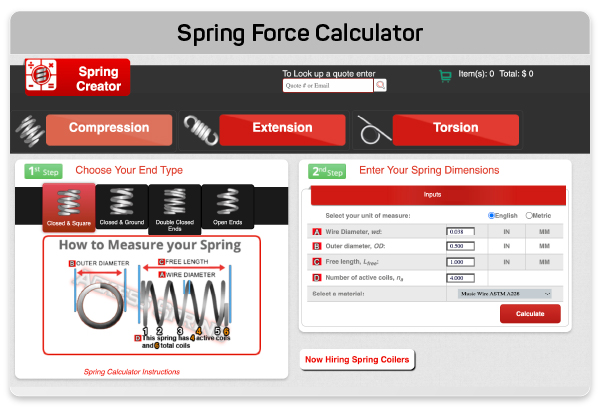
If you can’t find your exact OD/WD/FL combo in stock, the store’s intended “next step” is Spring Creator, which works as both a coil spring size calculator and a bridge into custom quoting.


Spring Creator is a free tool that:

  • Generates a full spring analysis with a downloadable 3D CAD and a 2D blueprint from your physical dimension inputs.
  • Lets you input core dimensions (wire diameter, outer diameter, free length, active coils, material, end type) and then calculates the rest (rate, deflection, load checks, etc.).
  • Runs a quick search and lists similar springs in stock, so you can often grab a “close match” right away even if your first design isn’t stocked exactly.

And if you want the human shortcut (recommended when you’re dealing with heavy-duty coil springs, tight tolerances, or anything safety-critical), contact the spring experts and tell them your target OD, WD, FL, and loaded height/load goal. We’ll help you pick stock or quote custom.

Contact page: https://www.thespringstore.com/contact

Phone: (951) 276-2777

Email: sales@compressionspring.com

Spring Creator 5.0 Spring Creator 5.0


What to remember for finding the right spring by size?

Before you click away to shop, here are the five rules I want you to remember, because they’ll save you time, money, and at least one late-night redesign.

  • Start with fit-first spring dimensions: outer diameter (or inner diameter) and free length are the fastest way to narrow your options. 

  • Use ranges, not single numbers: Spring Finder is built for min/max inputs so you can search by tolerance like a real engineer. 

  • Don’t underestimate wire diameter: even tiny changes (like 0.001") can meaningfully change spring behavior—especially in small coil springs. 

  • Use “standard” size families when you can: fractional OD pages are an easy on-ramp when you’re shopping coil springs by size without a part number. 

  • If stock doesn’t match, design and quote immediately: Spring Creator creates a blueprint and analysis and points you to similar in-stock options, so custom doesn’t have to be slow.

Now do the practical next step: search our inventory using Spring Finder and, if you need to design around a tight constraint, run your numbers through Spring Creator. If you want a fast expert review, especially for custom springs, reach out, call (951) 276-2777, or email sales@compressionspring.com, and we’ll help you get to a spring that fits, works, and holds up.