






Free Position of Torsion Springs
What does the Free Position of a Torsion Spring Refer To?
The free position of a torsion spring, also known as unloaded position, is the angle that the torsion spring’s legs create when it is in its relaxed state before any load is placed on it. The angle is determined by the total amount of coils in the spring since the legs start at the point where the coil ends.
To figure out the free position of a torsion spring’s legs based on the total coils, you need to be aware of different aspects of the torsion spring. First, it is important to understand the relation between coil count and the degree of the legs. When the coil amount has a .25 ending such as 4.25 coils the free position is of a 90º (degree) angle. This is because when a spring has a solid number of coils without a fraction of coils such as 2, 3, or 4, etc. the tips where the coil terminate meet at the top of this spring. This leads to the formation of a 0º (degree) angle and the legs in this position form a straight line.
When the torsion spring’s legs need to be at an angle during its free state (when no load or pressure is being placed on it) a fraction of a coil must be added or subtracted in order to get the desired result. The following examples and formulas explain more on how to actually calculate the torsional spring dimension of your torsion spring’s free position.
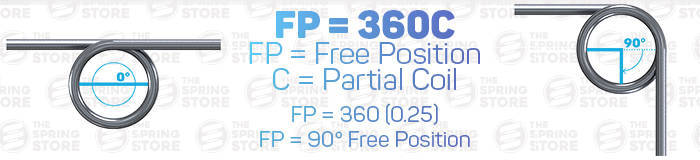
Example A.)
You have a spring with 4.25 coils. Since you have a “fraction” of a coil at the end of your torsion spring, you will calculate it as such and convert it into degrees by multiplying the partial last coil by 360º. This means you will multiply 0.250 by 360º as shown in the formula and diagram provided.
- Fp = Free Position
- C = Partial Coil
Example B.)
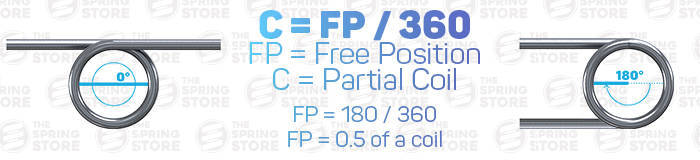
If the device demands that the torsional spring have a free position of 180º how many coils does your spring need to have in order to achieve this free position? To figure this out you must work backwards. Divide your free position of 180º by the 360º and you will get the fractional or partial coil you will need to add to the spring in order to achieve this free position.
- Fp = Free Position
- C = Partial Coil
The direction of wind of your torsional spring also has a lot to do with your spring’s free position and it will make a difference when being installed. When designing your designing your torsion spring, you must take into consideration which leg will be stationary and which direction you expect the other leg to rotate or deflect. The legs will only be able to travel inward as shown in the deflection diagram provided below.
Determine Your Direction of Wind
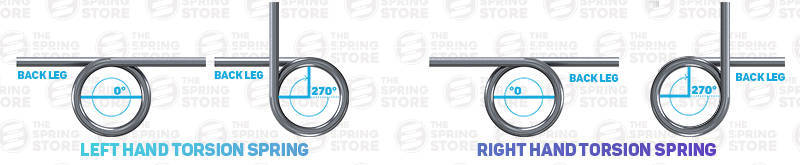
To determine the direction of wind on a torsion spring, you must place it in a way to where you’re looking down the center of the inner diameter and the back leg must be horizontally on top. If the back leg is pointing to the left, it is a left hand torsion spring, if it is facing to the right, it is a right hand torsion spring. No matter which position your spring is in, the direction of wind will remain the same. Take a look at the images provided below to see some examples about how the free position affects your spring design and how to determine the direction of wind.
Free Position Diagrams
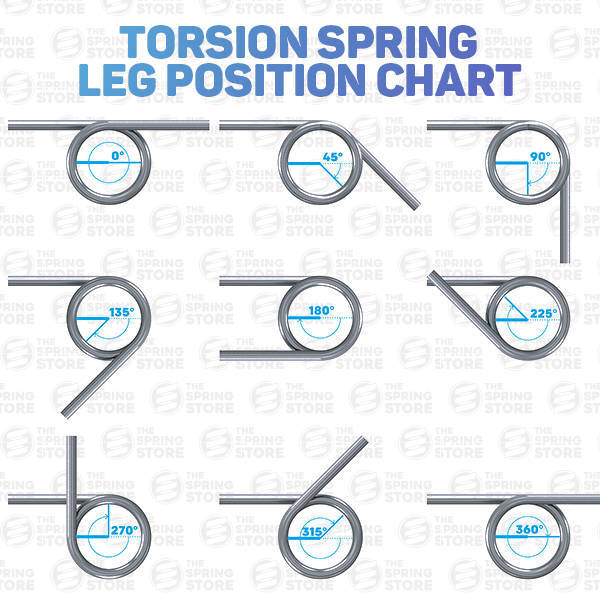
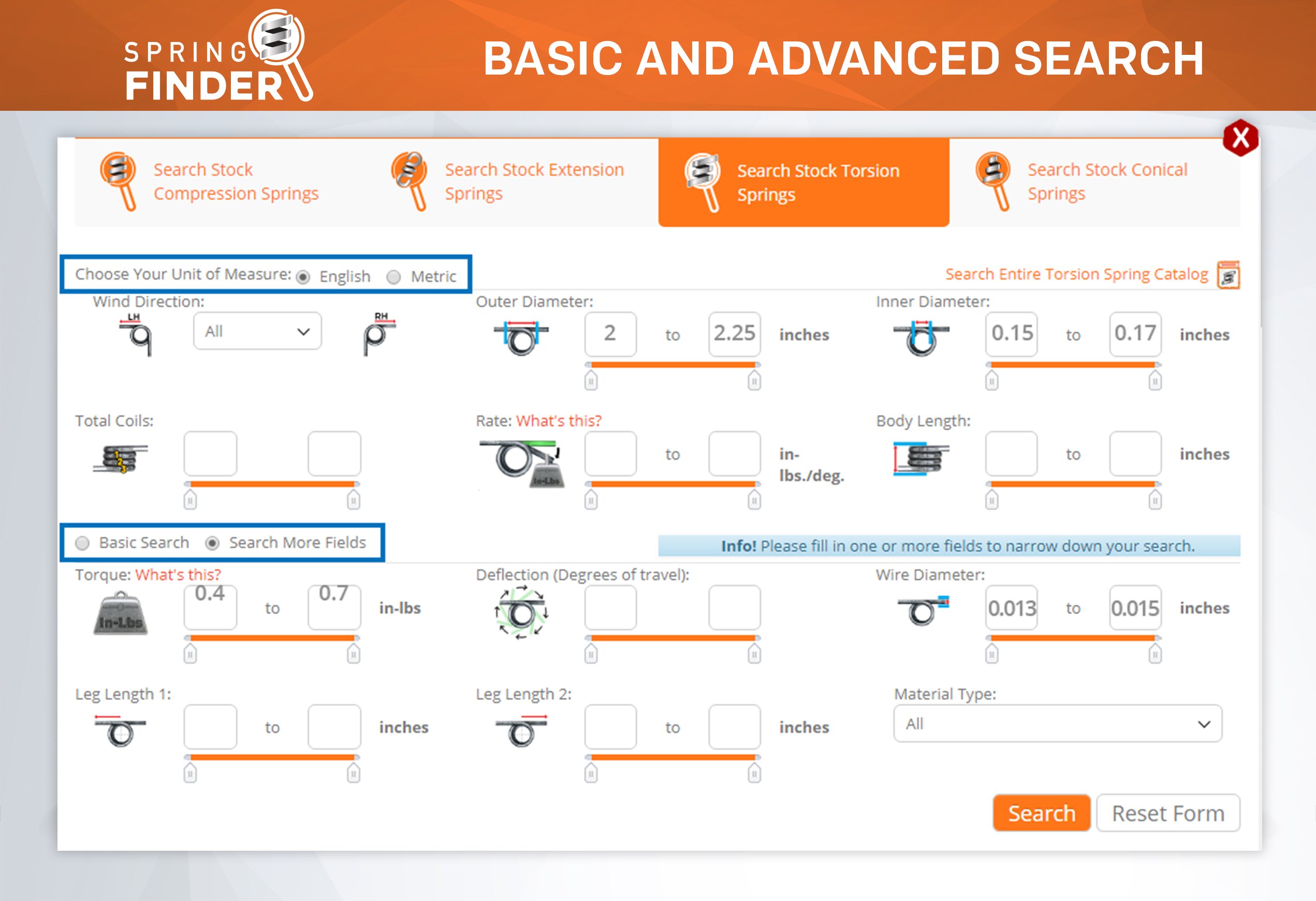
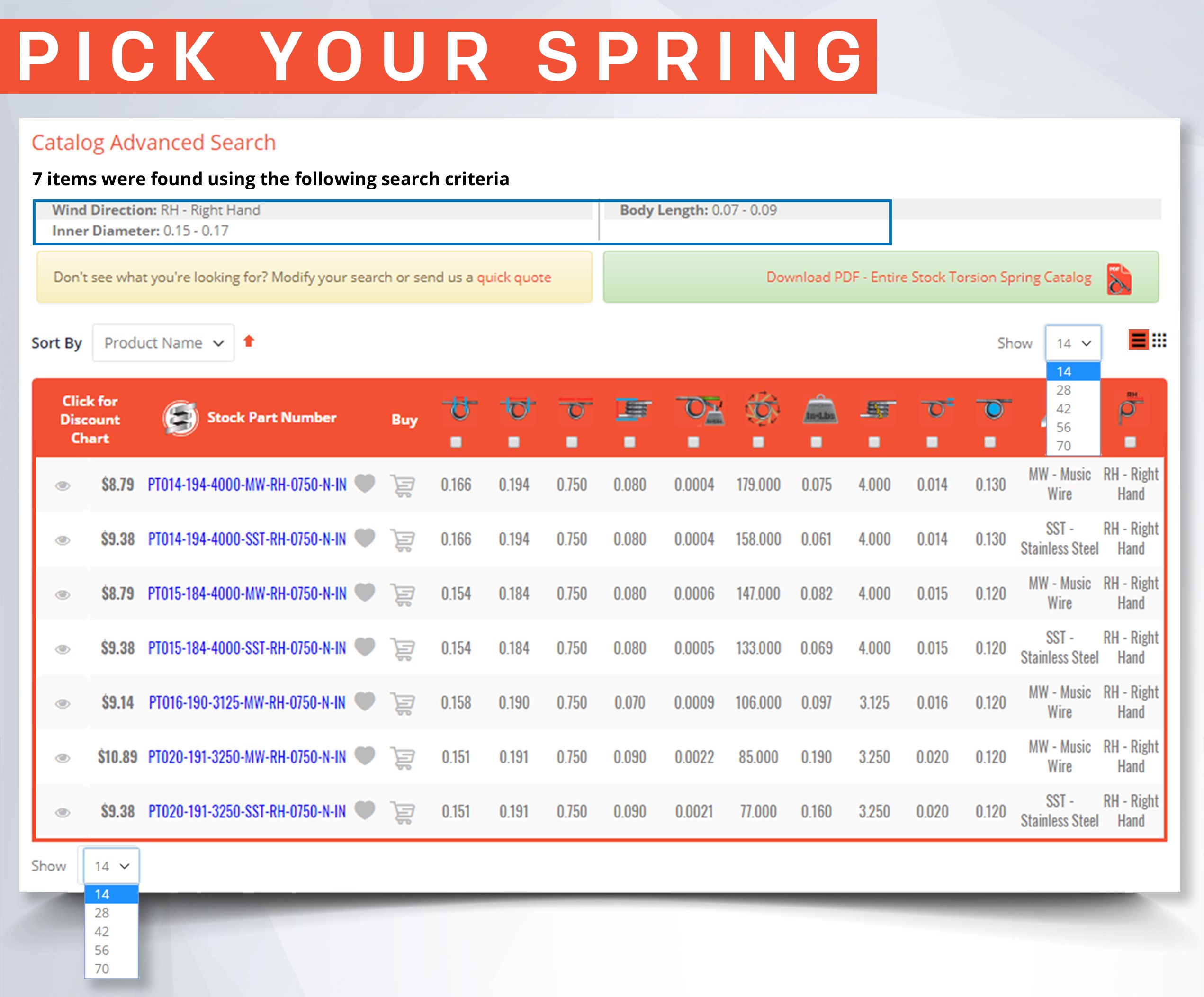
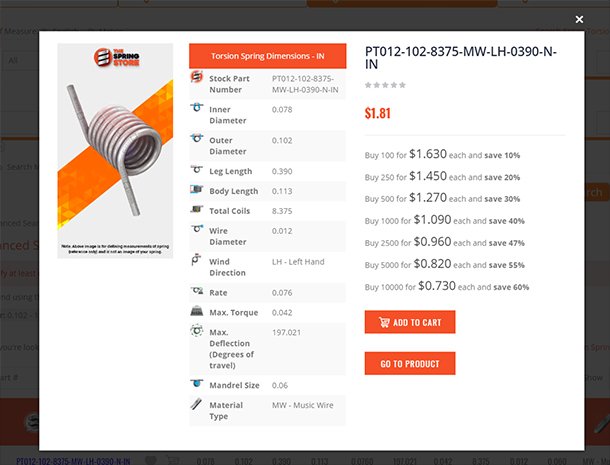
Finding the right stock torsion spring can be a bit trickier than finding other springs in stock such as compression and extension springs, however, we make this simple at The Spring Store. We provide the number of coils the spring has for all our stock springs, all you have to do to determine the position is multiply the end by 360 to obtain the degrees of the spring. If you have any additional questions or suggestions you can contact us directly at (951) 276-2777 so you can place your order with confidence.